

Kalamazoo Math Carnival ignites local students’ curiosity about math
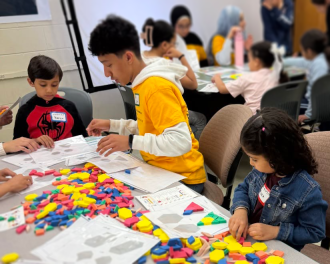
KALAMAZOO, Mich.—Last November, the inaugural Kalamazoo Math Carnival brought over 400 local grade-school students and their families to Sangren Hall to enjoy 30 creative math-themed activities designed for learners of all levels. Mathematics professor Dr. Mariana Levin created the carnival to invite participants to experience math through games and real-world applications, rather than the memorization and timed tests that so often crush students’ interest in the subject.
“We designed the space so that it’s a place where people can find what they gravitate toward and really sink into them, but it’s also okay for them to move freely through the space, kind of like a museum experience,” Levin says.
She first got the idea while working with her husband, a math professor at Michigan State University, designing enrichment activities for their children and the math club at The Montessori School in Kalamazoo. She envisioned the carnival as a space that could foster an appreciation of math among local students and strengthen WMU’s involvement with the surrounding community.
“It’s an opportunity to be playful and curious,” Levin says. “That is one of the things that I want my future teachers to take with them into the classroom—that kind of joy in doing math because I think that that’s one of the things that they’ll pass onto their students.”
Deeply passionate about training the next generation of future educators, Levin also seized the opportunity to involve her math education students, providing them with hands-on experience teaching math to young learners. Over 60 students volunteered to facilitate last year’s activities after practicing in class to strike the perfect balance between guiding participants and encouraging independent problem solving.
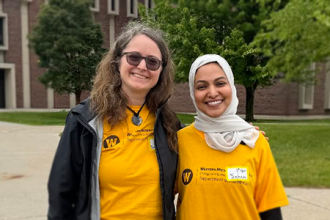
Seham Al Sidran, one of Levin’s doctoral students who helped organize the carnival, was thrilled to join the project because it resonated deeply with her ethos of “learning through playing.” She translated a few of the activities into Arabic with the goal of eventually bringing them back to her home country of Saudi Arabia, where she previously worked for many years as a high school teacher. But her initial work soon blossomed into an Arabic-language version of the Math Carnival that hosted more than 40 students and their families last May.
Parents were thrilled to find a space for their children to practice Arabic and to engage in math as a family. Understanding their children’s problem-solving processes helps parents learn how to better support them as students, Al Sidran explains.
“It’s more competition in the Arabic carnival and more community, more communication with the parents and friends,” she says.
Levin notes that the event’s intimate environment allowed for deeper collaboration than the much larger November carnival.
“When somebody solved a puzzle or solved some of the challenges’ later puzzles, there was an eruption of joy,” Levin remembers. “Everybody who came was celebrating when somebody persisted and then figured something out and had that ‘aha’ moment.”
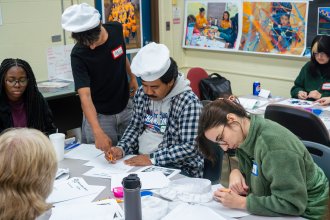
Many families who attended last year’s math carnivals have already registered for this year’s event on November 21, which will have an “Alice in Wonderland” theme. For example, the “White Rabbit Bakery” activity will give each student a chef’s hat and a “cookbook” for the magical cakes in Lewis Carroll’s novel. Students will be challenged to develop “recipes” using numbers and mathematical operations.
The “Mad Hatter’s Tea Party” station will contain logic puzzles that encourage students to create a seating chart for the tea party that satisfies the seating preferences of each character.
Some favorite activities from the past carnivals will also be included, such as a puzzle that challenges students to use different combinations of blocks to make a hexagon. Each participant is invited to add their solution to a community chart, displaying just some of the thousands of possible answers.
Another popular activity last year was the pi station. By measuring real-world circular objects, students can directly observe that the ratio of the circumference and diameter of all of them equal the same number – pi. Levin explained that the activity was especially interesting to teachers looking for creative ways to celebrate Pi Day—March 14, which is the first three digits of pi when written numerically—beyond the popular traditions of eating pie or reciting some of the famously long number.
Naline Beshay, a math education doctoral student who joined the planning team for the upcoming carnival just days after arriving at WMU this fall, emphasized the importance of real-world applications such as these in encouraging students to appreciate and better understand mathematical concepts.
“I think that initial start of having it not be play based or embedded in our real world—a lot of people might lose their interest in math throughout that process,” Beshay says.
She continues: “When I got lucky enough to have teachers that let us explore and learn for ourselves and lead our own thinking, that, I think, launched my interest in math way more because I was like, ‘Yes, I see how this is relevant. I see the fun in this and the beauty in the math that we’re working on and trying to show our students to be passionate about.’”
Levin echoes this sentiment.
“The early spark for me was beginning to see relationships between different flavors of math, like seeing how algebra and trigonometry both fed into calculus and seeing how that is a model of our natural world,” she says.
She hopes to instill this joy in even more families at this year’s carnival.
“Math is a human construction, and we get to be a part of that,” says Levin. “It’s constructive. It’s creative. There’s an aesthetic piece. There’s wonder, and I think the wonder is very important.”